
Value Types in a Calumet County Property Record
In Calumet County, a single property record can carry three different values. Each answers a different question. The assessed value drives taxation as of the annual assessment date. Market value estimates what the parcel could ordinarily bring in a private sale. A last sale price reports what a completed transaction actually paid. This appears when the record holds one. Not every Ascent parcel card shows a sale price or a value history. Check the live result, and note its year.
| Number | What it describes | Record source |
|---|---|---|
| Assessed value | Annual tax value using Wisconsin’s full-value basis | Municipal assessor and county roll |
| Market value | Ordinary private-sale value at a stated date | Assessment method or separate appraisal |
| Last sale price | Price in a particular recorded transfer | Deed and transfer information, when available |
| Land and improvements | Two parts of the assessment; Calumet says only total is appealable | Assessment record |
The numbers differ because they measure different things at different times. An assessed value is not a promise of the next sale price. A sale price does not become the next assessment by default. An appraisal stands apart, with its own scope and date. When comparing, write the source, year, and type next to each figure. That habit prevents most confusion.
Calumet County Values Use a January 1 Date
Wisconsin uses full value, described by Calumet County as the price ordinarily obtainable at a private sale. Taxable property is valued annually as of January 1, with those values used on bills created in December. Municipal assessors set the values in the general process and submit them to the county Real Property Lister. That local assessor structure matters: a parcel’s value question may need the municipal assessor as well as the county roll.
The county describes the January date and full-value basis but does not publish a fixed Ascent refresh timestamp. A value shown in a parcel record should be read with its year and assessment date. A sale later in the year may be useful evidence for a future cycle, but it does not turn the current assessment into a live sale appraisal.
The county’s assessment page explains the full-value standard and annual date.
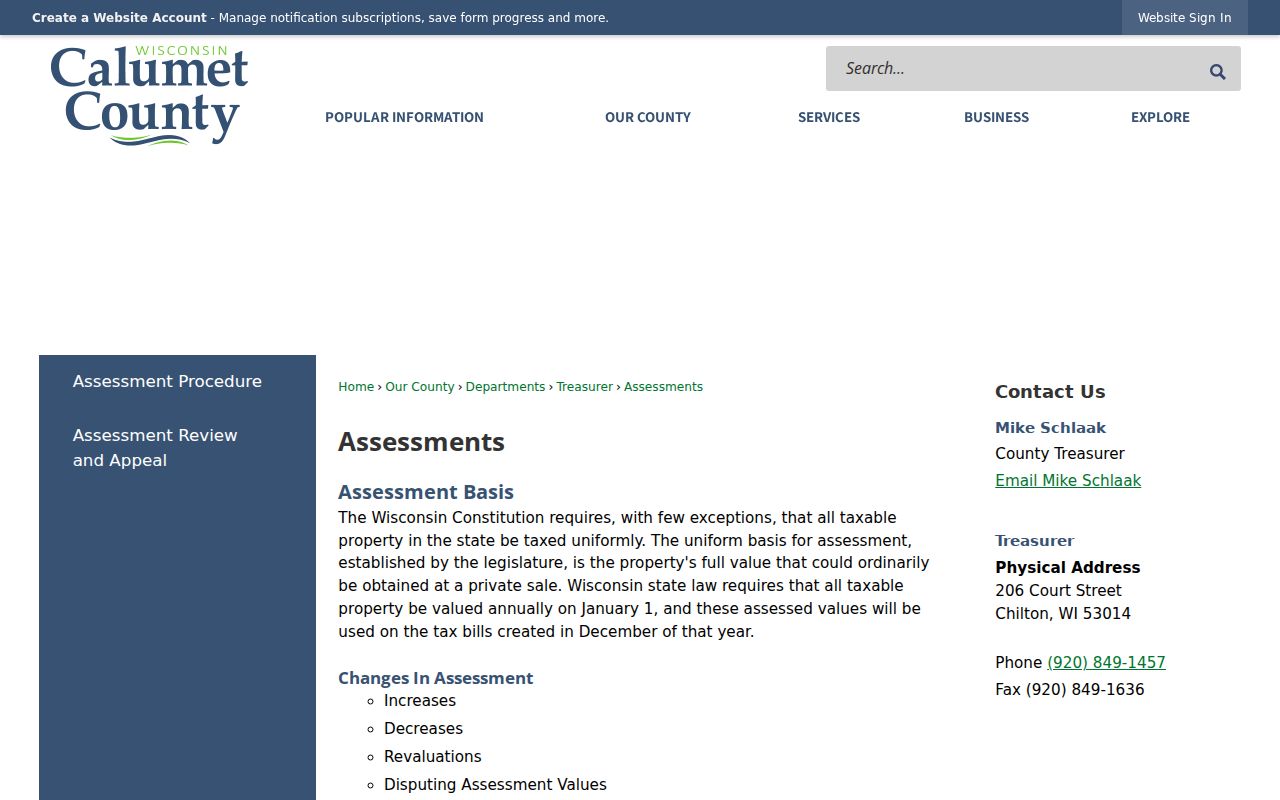
The screenshot is the county’s assessment guidance, not a sample owner-specific value card.
Land, Improvements, and Calumet County Total Value
An assessment record breaks value into land and improvements, such as a house or outbuilding. Calumet County allows appeals of the total only. One part can shift without moving the total by the same amount, since the assessor weighs the parcel as a whole under the assessment method. When a notice arrives, keep the land figure, the improvement figure, and the total side by side.
Permitted work, like a garage or room addition, can change the later record. The county also lists a sale of the property, comparable sales, and a shift in the general level of assessment as reasons values move. A contaminated water supply, failed septic system, or major neighborhood change can sometimes support a decrease. Before comparing years, ask what facts sit in the local assessor's file.
Recorded Sale Price in Calumet County
A recorded sale price belongs to a single transaction. It may surface in a deed or a transfer-tax return. Not every Ascent parcel card carries a last-sale field, though. The Register of Deeds records the instruments. Municipal assessors receive copies of real-estate transfer-tax returns. When the sale amount matters, rely on the recorded deed and its date first.
Prices drift from market value for many reasons. Timing, condition, included land, family terms, and other deal details all play a part. A sale price is a data point, not an appraisal for a later date. Comparing a parcel against a nearby sale? Confirm the legal description, sale date, and land area, not just the street address. A new recorded price may inform a future assessment cycle without setting it.
To pair an address with location identifiers, use the Calumet County property-search route.
Why Calumet County Assessed Values Change
Assessment changes in Calumet County can trace back to several causes. Improvements, a sale of the subject parcel, comparable sales, or a general shift in the level of assessment all play a part. Building permits tip off an assessor to a new room or garage. Values can also fall. The county recognizes several supporting conditions. Contaminated water, a failing septic system, or a significant neighborhood change can all support a reduction. Treat these as talking points with the assessor, not a formula for the parcel.
Each municipality contracts its own assessor in the general process. Request the assessment roll and any notice. Then compare the land, improvement, and total fields against the evidence. An increase of $300 or more triggers written notice. It comes at least ten days before Board of Review, per the county. That notice still does not make the total assessed amount an expected sale price.
Compare Assessment Levels in Calumet County
Wisconsin uses a full-value basis, so a Calumet County assessment carries a market reference. The county publishes no parcel-specific assessment ratio and no current table of municipality-by-municipality ratios. That matters. A ratio belongs to a set period and jurisdiction. Avoid deriving a market price by multiplying or dividing an assessment unless the source and year plainly support that math. A sale, an assessment, and a tax bill may each rest on a different date, so the numbers can drift apart for innocent reasons.
Calumet County mill-rate material shows district rates and how they shift. That is not a property-value trend. A levy, equalization order, school district, or municipality can move a bill without moving the parcel's market price at all. Keep value questions and amount-due questions in separate piles. The Calumet County tax-record page covers bills and review steps in detail.
Look Up a Calumet County Assessed Value
Use Ascent Real Estate Tax Parcel to find a value entry. The entry is tied to an address or a Location ID. The county publishes no exact live search-field labels and no sample card. So verify the result rather than assuming which values appear. Note the assessment year and the municipal context. Does the portal return no clear value? Then ask the local assessor for the roll and the current notice.
- Search the property by address or Location ID in Ascent.
- Copy land, improvement, and total amounts with the displayed year.
- Check the deed for a recorded sale amount if the record supports it.
- Ask the municipal assessor how the current total was set.
- Assessed value
- The annual figure carried for property-tax purposes.
- Market value
- The price a property could ordinarily bring at a private sale.
- Sale price
- The consideration for one completed transaction.
- Reassessment
- A later valuation cycle that may reflect new facts or the general level of assessment.
Exemptions and Calumet County Value Entries
An exemption changes how value gets used for tax purposes. Calumet County publishes no complete exemption list, and local record fields vary. Check the parcel record itself. Ask the municipal assessor which entry applies, what it changes, and which year it covers. Never infer an exemption from an owner of record's name, a mailing address, or a result from another jurisdiction. Those clues prove nothing.
Keep four things separate: assessed value, taxable value, exemptions, and the final bill amount. A bill can change because of district levies or an exemption entry. This can happen even when the physical parcel has not changed at all. The county's general materials describe the assessment and appeal process. Current program details should come from the custodian responsible for the parcel.
Calumet County Property Value Is Not a Sale Appraisal
An assessor's number is a mass-appraisal figure built for tax purposes. It is set at a defined date. It is not a promised sale amount. It is not a private appraisal either, and no buyer is bound to match it. A parcel's market can move after January 1 while the roll follows its own cycle. An appraiser weighs a particular assignment and effective date. A title professional answers a different ownership question altogether.
For a consequential sale, refinance, or legal matter, get a qualified appraisal. Review the recorded deed separately. Calumet County's assessment record still earns its keep as tax comparison and appeal evidence. It just should not be stretched into a current offer price.
Limits of a Calumet County Assessed Value
A Calumet County assessed value is a tax figure pinned to an annual valuation date. It may differ from the last sale price. It can also differ from a buyer's offer or an appraiser's opinion. Each number answers a different purpose at a different time. The value can support an assessment review. It cannot certify what the parcel would sell for today.
Value vs price. Assessed value is used for taxation; it is not what a Calumet County property will sell for and is not an appraisal.